

1. What happened? Timeline and announcement
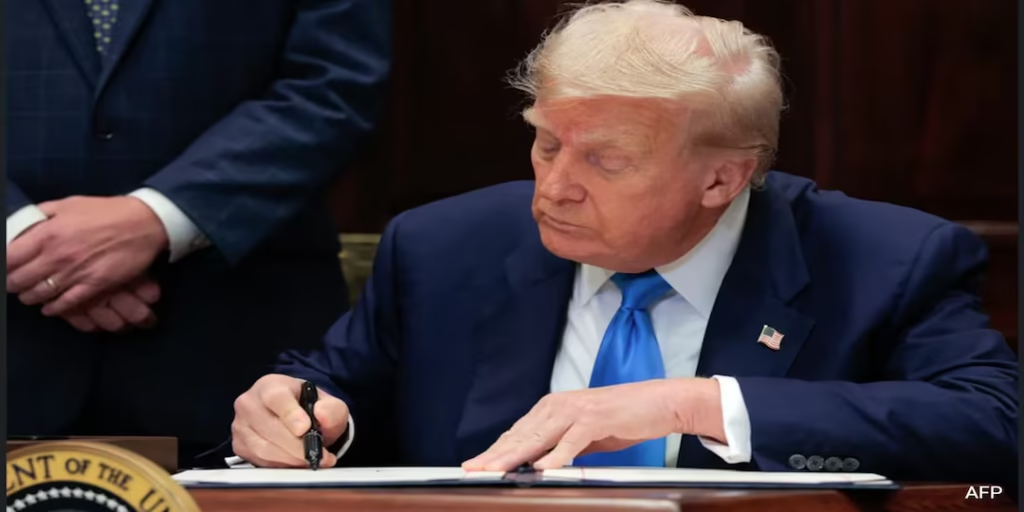
On July 30, 2025, U.S. President Donald Trump announced that starting August 1, all goods imported from India to the United States would face a 25% tariff, plus an unspecified additional penalty tied to India’s purchases of Russian military equipment and energy resources
Trump conveyed the decision via a post on Truth Social, calling India “our friend” yet lambasting its tariffs on U.S. goods, terming them among the highest globally, and pointing to stringent non‑monetary trade barriers He accused India (alongside China) of effectively propelling Russia’s war in Ukraine by buying its oil and military kit
While imposing the tariff, Trump also suggested ongoing trade negotiations: “We’re talking to India now… you’ll know by the end of this week,” hinting at potential scope for compromise
These tariffs arose as part of a broader “Liberation Day” tariff regime, launched in April 2025 via executive orders, including a 10% baseline tariff on most imports and higher country‑specific “reciprocal” tariffs. Countries with large U.S. trade deficits were hit with rates up to 50%. India was one of about 60 targeted nations
Simultaneously, Trump signed orders targeting copper imports (up to 50%), de‑minimised low‑value “de minimis” shipments, and tariffs on Brazil tied to its prosecution of former President Bolsonaro
2. Why India? India–U.S. trade friction and Russia tie
• India’s tariff profile and U.S. complaints
Trump criticized India’s average applied tariffs, highlighting rates near 39% on agricultural goods—with some like vegetable oils up to 45%, apples near 50%—labeling them “among the highest in the world” The U.S. average tariff, by comparison, is around 2.2%
• Trade imbalance and stalled bilateral talks
In early 2025, India and the U.S. held multiple negotiation rounds toward a bilateral trade agreement targetting bilateral trade volume of $500 billion by 2030. India resisted deeper access in sectors like agriculture and dairy, important for livelihood and food security, while the U.S. pushed for near‑zero tariffs on most exports . Previous talks were held during PM Modi’s February Washington visit, but major sticking points remained
• India’s ties with Russia
Trump’s punitive measures were partially motivated by India’s ongoing imports of Russian military equipment and oil. He accused India of being Russia’s largest energy buyer along with China, at a time when the global priority was pressuring Moscow to cease its war in Ukraine .
3. Economic and political reactions
• Market reaction in India
Financial markets responded quickly: India’s rupee plunged toward a record low, and equity indices fell sharply on July 31, following Trump’s announcement The Gift Nifty futures fell nearly 200 points, signaling market anxiety over export disruptions and economic fallout
• Domestic political criticism
Indian opposition leaders denounced the move:
- Congress MP Shashi Tharoor described the tariff and unspecified penalty as “completely unreasonable”, warning that if a 100% penalty is imposed, it would devastate trade
- Asaduddin Owaisi, leader of AIMIM, called Trump the “buffoon‑in‑chief” and accused the U.S. of a deliberate attack on India’s economic sovereignty, warning of damage to MSMEs, IT firms, agriculture, and FDI flows
• U.S. political/legal context
Experts in the U.S. flagged that the earlier Liberation Day tariffs might face legal challenges. In V.O.S. Selections, Inc. v. Trump, a U.S. court ruled the executive actions exceeded authority under the International Emergency Economic Powers Act (IEEPA), issuing a permanent injunction. The administration appealed, keeping tariffs provisionally in force
Meanwhile, lawmakers introduced the Trade Review Act of 2025, which would require Congressional approval for new presidential tariffs beyond 60 days—an effort to restore legislative oversight over trade decisions
4. Industry and sectoral impacts
• Apple and tech exports
Not all goods are affected equally—electronics including Apple iPhones made in India are currently exempt from the 25% tariff under an existing U.S. policy from April 2025 shielding major tech firms like Apple and Nvidia. India now supplies over 70% of iPhones sold in the U.S., up from 31% a year earlier. If the exemption is later revoked, those exports could face new costs
Analysts suggest that Apple is likely to absorb costs rather than altering its India investment strategy, given supply chain complexity and long‑term commitments
• Agriculture and other exports
Farm goods were a major sticking point in trade talks. India’s protective policy over agriculture aimed to safeguard smallholder farmers. However, a surge in U.S. agricultural imports could threaten that balance. Tariffs may further depress Indian exports in agriculture, pearls, minerals, and machinery—sectors estimated to face a 6–10% tariff increase, as per internal analyses
• Broader trade competition
India could lose export competitiveness to countries like Vietnam, Bangladesh, and perhaps China, all of which may offer lower tariffs and fewer penalties when selling into U.S. markets
5. Strategic implications and geopolitical ripple effects
• U.S.–India relations fray
The tariff move represents a sharp escalation after months of attempted rapprochement. Though India was seen as a strategic counterweight to China, these tariffs may erode Washington’s outreach toward Delhi and undermine strategic cooperation on Quad and defense partnerships
• Pivot toward Pakistan
Just hours after announcing the tariffs, Trump unveiled a new oil exploration agreement with Pakistan, raising eyebrows about a potential U.S. realignment away from India toward Islamabad—a dramatic turn in regional diplomacy
• Global trade turbulence
Trump’s broader tariff regimen extends beyond India: similar steep tariffs were announced on Brazil (50%), copper imports, and possibly Australia (which fears its current 10% tariff baseline might rise to 15–20%) Economists note rising inflationary risk and trade distortion concerns globally
Fed watchers took note: despite economic growth of 3% in Q2 2025, underlying fundamentals may be weaker—impacted by trade protectionism and market disruptions. The Federal Reserve opted to leave interest rates unchanged, resisting pressure from Trump to cut rates even as trade friction escalated
6. What’s next? Unfolding scenarios
• Negotiations and conditional relief
Trump indicated some flexibility. Discourse continued through the end of that week to determine whether tariffs and penalties could be scaled back or delayed, contingent on deal progress
Indian officials stated New Delhi remained committed to achieving a “fair, balanced, mutually beneficial” trade deal, while studying the implications of the tariffs
• Legal challenges
The legality of Trump’s broader tariff strategy—including on India—is under judicial scrutiny. The Trade Review Act if passed may limit executive authority going forward. Meanwhile, legal challenges continue to question the scope of presidential powers under emergency statutes like IEEPA
• Economic adjustments
In India, exporters may re‑engineer value chains toward tariff‑friendly markets. A slowdown in exports could lead to reduced export volumes or diverted trade flows to alternative destinations.
In the U.S., companies dependent on Indian goods could face price hikes, delayed shipments, or supply chain disruption. Apple may initially avoid impacts via exemptions, but other sectors (auto parts, pharmaceuticals, gems & jewellery) may be significantly affected
7. Broader analysis and perspective
This episode illustrates the evolving Trump doctrine of reciprocal, unilateral trade action—revealing how geopolitical alignment (e.g. with Russia) becomes intertwined with commercial policy. India’s balancing act—maintaining relations with both Moscow and Washington—cannot shield it from economic coercion when foreign policy diverges sharply.
What is notable:
- Tariffs are the front-line tool for Trump’s negotiating arsenal, doubling as both friction and leverage.
- Emerging strategic rifts: India’s role as a stable partner seems undermined as U.S. policy appears transactional.
- Judicial and legislative check: Legal challenges and legislative proposals in the U.S. suggest growing institutional resistance to expansive executive trade powers.
About the Author